V-Desk debt collection
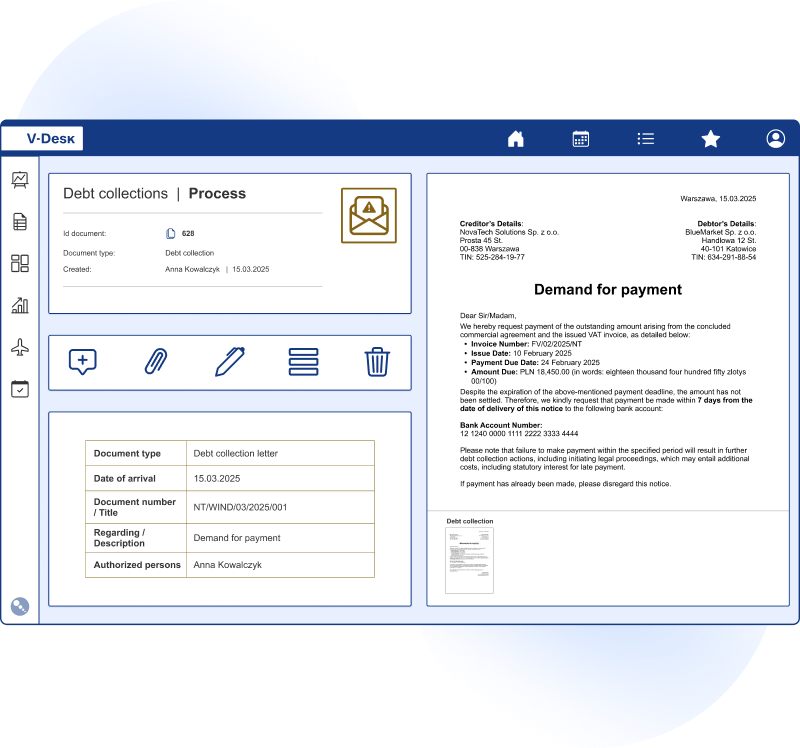
The debt collection module in the V-Desk system is a comprehensive tool supporting the handling of debt collection cases in the shortest possible time.
The application will help increase efficiency and optimise the use of resources in the area of debt collection, focusing on positive relationships with counterparties, business scaling and growth. The solution uses a set of tools and mechanisms based on a workflow engine to streamline the process.












What do debt collection departments struggle with?
Inefficiency of the traditional debt collection process
Working without the support of customised tools requires a great deal of time and resources.
Automating tasks and digitalisation brings optimal processing, eliminating delays and errors. Analysing payment data and assigning the relevant statuses in one place saves time and allows you to focus on other tasks.
No automation of email notifications
Traditional emailing is both time-consuming and error-prone.
The V-Desk system will allow the automation of reminder dispatches whether directly to contractors or those responsible for the task.
Restrictions on control of the recovery process
Based on simple tools or traditional sheets, processes lose transparency.
The system makes it possible to monitor the progress of debt collection work. The user can keep track of what actions have been taken as part of the debt collection process and the effects of these actions, enabling effective management of the debt collection process.
What do you gain by choosing an electronic invoice workflow in V-Desk?

Viewing of cases in dedicated reports and statements
Integration with the invoice module
Access to always up-to-date data
Control of payables and receivables – invoice collection
Reducing the costs of the invoice collection process
Ongoing analysis of debt collection documentation
Easy analysis and minimisation of overdue receivables
Rapid response to late payment
Full analytical information on collected receivables by collection case
What does the debt collection process look like step by step?
In V-Desk, you can organize the debt collection process so that it is repeatable, measurable, and scalable. Everything takes place in one system—from the first reminder to escalation actions—with full case history and deadline control. A process-based approach ensures consistency, and the collection team works according to clear rules regardless of the number of cases.
The process may include:
- automatic case creation based on invoice data or receivables list,
- assignment of a case owner and priority based on amount and overdue period,
- planning subsequent steps (reminder, payment demand, follow-up),
- approval and sending of documents according to internal rules,
- recording arrangements with the contractor (e.g., payment declaration) and updating deadlines and case status,
- case closure or transfer to the next stage if no response is received.
Automatic communication and complete contact history
Debt collection involves not only documents but also fast, structured communication. V-Desk helps maintain order in contractor contact and reduces the risk of errors resulting from manual sending. As a result, you gain a consistent communication standard, easier case handovers between employees, and full transparency of arrangements without searching through email inboxes.
The system can support:
- sending notifications and reminders according to the process schedule,
- using standardized message and letter templates,
- registering responses and agreements (e.g., payment declarations, new deadlines),
- viewing the action history—who performed which step and when.
Control over the receivables portfolio
As the number of cases grows, prioritization and ongoing monitoring become crucial. V-Desk organizes the receivables portfolio and supports operational decision-making based on current data. Debt collection stops being reactive firefighting and becomes a predictable process that can be improved and developed alongside the business.
In practice, this means:
- reports and summaries showing case statuses and overdue items by stage, contractor, and owner,
- quick identification of cases requiring immediate action (e.g., after exceeding deadlines),
- monitoring team workload and transparent task allocation,
- consistent case handling rules across the organization.
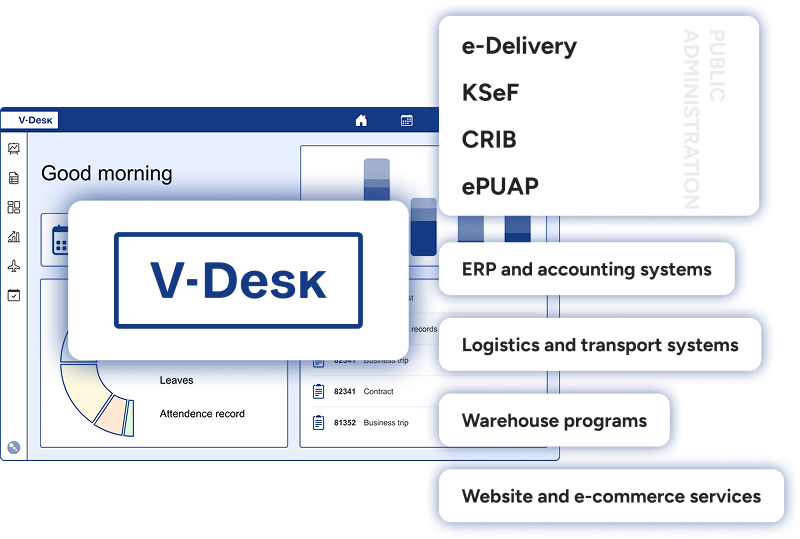
We will integrate V-Desk into your ERP system
The advantage of the V-Desk system is that it can be integrated with virtually any IT system. There is no company on the market that does not already use some software. The whole magic is to integrate any software used in the company with V-Desk in such a way as to improve the business processes in the organisation.